Structured Stories with
Eyewitness Control
The Case for the Traditional
Solution
By: Erick Nelson
Last Updated:
May 24, 2004
Recap and Introduction
In the preceding chapter, I explained how I accidentally became convinced that Matthew, Mark, and Luke did not copy from each other - simply from reading their accounts (in English) side by side, and wondering just why they would deviate from each other's wording in the way they do. In that chapter I also briefly reviewed the various models that have been presented over the years, and pointed out that even though this is generally considered a settled issues (one of the few), many scholars claim it is far from settled.
I also looked at some of my reasoning regarding the issue of Verbal Agreement, and closed the chapter by wondering if there wasn't something more, something big, that I was missing. One of my obstacles is that 95%+ of the discussion about the Synoptic Problem has to do with deciding which gospel is the source of the other two. An unbelievable amount of material is devoted to statistics, tables of agreements/disagreements, arcane discussion of possible dependencies, all in the attempt to defend Marcan priority (the majority view), Matthean priority (the Greisbach hypothesis, popularized by Farmer), or some other arrangement. Rarely do they go back to the foundations and explain just why they think there is any direct dependency at all.
The Case for the Traditional Solution
And so I asked Dr. Mark Allan Powell, who chairs the Historical Jesus Section of the SBL and is a Matthew expert (among other things) if he know of any books that discuss these foundations, and make an explicit case for the direct dependency rationale. He confirmed to me that the majority of scholars do hold the "traditional" view, and that questioning it would certainly be an up-hill battle. He pointed out that several arguments are used which, considered together, present a rather convincing case to most scholars. And, in direct answer to my question, he also kindly sent me a copy of the relevant portions of Robert Stein's The Synoptic Problem: An Introduction. He wrote:
"Read the enclosed piece by Robert Stein - an apology for the majority view - these are the arguments you will have to engage. I know you've probably heard all this before, but if you haven't seen Stein's piece, he lays it out in a manner that is pretty clear - he shows (in chap. one) why most scholars think there must be some literary dependence." (letter to me, approx 5/9/2003)
Although I am indeed familiar with many of Stein's, he did present arguments that were new to me. More important, this is a helpful work because he does lay out the arguments clearly and logically. And so I will look at his arguments. The issue I wish to consider is:
What reasons are there for concluding that there is a direct literary dependence between the synoptics?
This is Stein's argument:
A. There are four lines of evidence which point to one common written source for the synoptics:
- Agreement in wording
- Agreement in order
- Agreement in parenthetical material
- Luke's Prologue
B. The one common external or "proto-" source, Ur-Mark, which is the most likely external source, is reduced under analysis to Mark itself.
C. Several factors all point to the priority of Mark (an issue not addressed in this article).
One Common Written Source
1. Agreement in Wording
Agreement in Wording -> (plural) written sources
Stein says, "The easiest way of observing the close similarity in the wording of the synoptic Gospels is to underline the agreements that exist between them in parallel passages", and then goes on to recommend a highlighting approach to the parallel pasages. I believe this issue is absolutely crucial to the question, and so we will spend a considerable effort looking at actual cases, as Stein recommends. I will here only quote his conclusion, and examine this contention later. Stein contends,
"... the exact wording seen in the passages just underlined argues for some sort of a common source, either oral or written, that lies behind the similarities of the synoptic Gospels." (p 34)
Later, somewhat inconsistently, he amends this later (without further argument) to:
"... the exactness of the wording between the synoptic Gospels is better explained by the use of written sources than oral ones." (p 43)
Note, that (at least as Stein presents it), the verbal agreement is not necessarily sufficient in itself to warrant the conclusion that the three synoptics copied directly from each other. He only makes the more modest claim here that verbal agreement indicates one or more (possibly several) written sources. I don't disagree with this at all.
It is the combination of arguments which indicates direct literary dependence, especially the combination of this argument with the next one.
2. Agreement in Order
Agreement in Order -> One common written source.
Many scholars have pointed out - and I accept their contention - that Mark is in many ways the "middle term" between Matthew and Luke. There does seem to be, for the most part, a common order to the synoptic narratives. Because of this, Stein concludes,
"As a result it would appear that some common source served as a pattern for this similarity. It would also appear that such a source would more likely be written than oral, for such lengthy and precise agreement is more difficult to explain on the basis of using a common oral tradition than on the basis of a common written source." (p 37)
What should we say about this? I believe without common order, the argument from verbal identity alone would never have been convincing enough to win the day ... but I am getting ahead of myself. It is the combination of these arguments which carries the force. Here's why. If you notice that the order of two documents is the same, and the wording is often the same, you naturally assume that both the order and the wording are due to one document.
But is this necessarily so? What if the sources for the "common order" and "common wording" are different? For I notice immediately that the most the Argument from Order can establish by itself is that the synoptics followed similar outlines.
I wonder - Did people in those days ever take notes, create lists, or did they always write fully-formed narrative prose? It seems intuitively obvious that they would be capable of writing lists, that lists and notes might actually be more common in a world of scarce writing resources, and that the early Christians surely might have jotted down lists of the events in Jesus' life (among other things). Haven't archeologists found invoices and lists in the rubbish heaps of antiquity?
And so I believe a plausible scenario could be constructed as follows:
- As the apostles told and re-told their stories, people took notes
- The stories were part of the "liturgy" of the early church
- It would have been easy to create
chronological/topical lists of the stories:
- Feeding of the five thousand
- Jesus walks on water
- Jesus heals the leper
- etc.
- It would also have been natural for these lists to become part of the worship pattern of the early Christian communities; early lectionary material
- It would also have been natural for one basic flow (Peter's?) to become the dominant pattern, with several variations in specifics
But isn't positing sets of lists, or outlines, simply relying on non-existent sources? I don't know if there is any evidence that the first century Christians created such lists. Even if there is no such evidence, this approach is somewhat more restrained than, for instance, the insistence that Q is a specific document containing clearly identifiable sayings.
3. Agreement in Parenthetical Material
Agreement in Parenthetical Material -> One common written source.
Stein sees the argument regarding agreement in parenthetical material as especially important:
"One of the most persuasive arguments for the literary interdependence of the synoptic Gospels is the presence of identical parenthetical material, for it is highly unlikely that two or three writers would by coincidence insert into their accounts exactly the same editorial comment at exactly the same place. It is furthermore evident in the example below that we can conclude that the common source of the material was written, for both Matthew and Mark refer to the "reader" in the comment." (p 37) (italics mine)
Stein's best example ("let the reader understand") comes from Matthew 24 and Mark 13, where the authors speak of the "Abomination of Desolation." This is an especially interesting case. I agree with Stein here that Matthew and Mark wouldn't just coincidentally come up with that same phrase, and if they used a common source, it was probably a written one.
But remember that this is the best example there is. However, is even this really persuasive? First, Luke's wording of this story is completely different from Matthew's and Mark's, and he fails to include the parenthetical remark at all! How is this an indication that all three writers used one common source?
Second, the other examples he presents are not even necessarily editorial asides or parenthetical remarks! I will not list them here, because I simply don't think this argument is very strong or important. You'll need to look them up for yourself. They are typically explanatory remarks (".... for he knew that it was out of envy that they had delivered him up"). His top three are:
- Healing (Matthew 9:18, Mark 2:1-12, Luke 5:17-26): Matthew "He then said to the paralytic"; Mark and Luke are similar
- Man of the tombs (Matthew 8:28-29, Mark 5:1-8, Luke 8:26-29): Matthew has nothing; Mark has "For he had said to him, 'Come out of the man, you unclean spirit!'; Luke has ""For he had commanded the unclean spirit to come out of the man."
- Barabbas (Matthew 27:15-18, Mark 15:6-10, no Luke): Matthew "For he knew that it was out of envy that they had delivered him up; Mark similar; Luke nothing.
Stein's other references are:
- Matt 26:5, Mark 14:2, Luke 22:2
- Matthew 26:14, Mark 14:10, Luke 22:3
- Matthew 26:47, Mark 14:43, Luke 22:47
- Matthew 9:21, Mark 5:28
Here's what I notice. I notice three things about these, his best examples. First, in 3 of 8 examples, not all synoptics include the passage. Second, when they do, they often use different wording. And third, only the first one - to my mind - is truly an editorial aside which requires explanation; the others really fit naturally into the "order" or "wording" arguments.
Now, if such passages were many and pervasive, and the parenthetical remarks appeared at odd places in all three synoptics, and if all three always or nearly always carried the same passages, this could become a compelling argument. But as we consider the best examples, I just don't see that this is the case.
Instead, the most that this argument, as it stands, can prove is that a few isolated passages were based on similar sources - potentially many of them. The choice Stein offers between "coincidence" and "one common written source" in his quote is surely a false dilemma; there is a tremendous among of middle ground available.
4. Luke's Prologue
Stein quotes Luke's famous introduction:
"Inasmuch as many have undertaken to compile a narrative of the things which have been accomplished among us, just as they were delivered to us by those who from the beginning were eyewitnesses and ministers of the word, it seemed good to me also, having followed all things closely for some time past, to write an orderly account for you, most excellent Theophilus, that you may know the truth concerning the things of which you have been informed." (p 42) (italics mine)
He gathers from this that:
"Luke no doubt 'followed' these things via these written narratives as well as the oral traditions available to him. The common agreement in Luke's 'narrative of the things which have been accomplished among us' with the other synoptic Gospels strongly suggests the use of a common source."
As an argument, this is particularly curious. Note that there is nothing in Luke's actual statement which offers the slightest evidence of "one common written source" of the synoptics (only that there were several written sources). Stein's contention is simply that the common agreement, established by the earlier arguments, which provides this evidence! And so this is not an independent argument at all.
Second, it should be noted that Luke's statement actually argues against the "one common written source" hypothesis. Luke specifically says that "many" have written such accounts. Even if "many" doesn't mean 20 or 30 or 50, it surely means more than one. As Stein himself points out, "following" these things includes collecting oral tradition, and in my view quite possibly interviewing the eyewitnesses personally.
Luke certainly in this very prologue had the opportunity to clarify this issue. He could easily have said, for instance, something like this: "Whereas an excellent narrative of the Lord's deeds (by Mark) has been published among the brethren, I thought it beneficial to enhance and supplement his story with an account of the Lord's words as well." But he doesn't - he merely lumps the "many" sources together, which would tend to support a multiple-source view (such as SSEC) rather than a direct literary dependence theory.
Surprisingly, Stein - in a much later part of his book where he is trying to explain the Matthew/Luke disagreements against Mark - goes out of his way to actually argue for many sources:
"It would be foolish to think that the only materials available to the Evangelists were one or two written sources. It would even be wrong to think that they possessed only a specified number of written sources. Since we know that the gospel traditions continued to be passed on in oral form for many years after our Gospels were written, we should not think that Matthew and Luke had only written sources before them. On the contrary, they had along with these written sources an even more extensive oral tradition, which possessed a fairly established form." (p 126)
My conclusion is that the argument from Luke's Prologue is at best irrelevant -and at worst, undermines his thesis.
Common Source = One of the Synoptics
As I mentioned in the first chapter, there were several attempts to introduce "proto-" gospels (or "Ur-" gospels, which means the same thing) to account for the differences in wording. A "proto-" gospel is an earlier form of one of the Synoptics or their sources. If Matthew and Luke, for instance, each copied from different translations of an earlier Aramaic Mark, or if they copied from different earlier drafts of Mark, then the verbal disagreements would be explained. Here is a chart of three such models, shown in the first chapter:
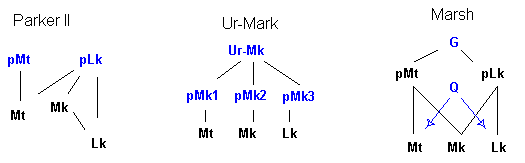
In fact, even back in the late 1700's, that's just what was hypothesized. G.E. Lessing and J.G. Eichorn posited an "Ur-" gospel, an earlier Aramaic version of Mark which was translated into possibly several Greek versions.
Stein comments on this attempt. He brings up two possible arguments against this approach. First, he considers the issue of postulating a hypothetical set of documents.
"This purportedly explains why the synoptic Gospels are both alike (the use of a common Ur-gospel) and at the same time different (the use of different revisions of the Ur-gospel). One argument raised against such a theory is the fact that no trace of such an Ur-gospel exists. However, such an 'argument from silence' is always dangerous, and it is certainly not an argument the followers of the Q hypothesis can raise, for there exists no trace of Q either!" (p 46)
And so, Stein does not see this as a valid objection. The second issue is that of the nature of Ur-Mark itself.
"The main problem with the Ur-gospel theory is that, as scholars began to reconstruct the configuration of the Ur-gospel from the common agreements in Matthew, Mark, and Luke, it began to look more and more like an Ur-Mark, i.e., it began to look more and more like Mark. In fact the Ur-gospel was soon simply called Ur-Mark. Yet as Ur-Mark was constructed, it continued to look more and more like our present Gospel of Mark. It therefore appeared that instead of postulating an Ur-gospel, the relationship between the synoptic Gospels could be better and more simply explained by some sort of an interdependence between them." (p 46)
And so, the real problem, he sees it, is that the more Ur-Mark was analyzed and defined, the more it just looked like Mark.
Response
How are we to evaluate this? For my part, I fail to see how or why Ur-Mark would have simply turned into Mark in this way. Surely, the double level of hypothetical documents provides the perfect environment for explaining any possible wording encountered in the three Synoptics. The Aramaic Ur-Mark provides the order, the framework, so we have common order. Three independent translations into Greek provide any desired combination of agreement/disagreement, tailor-made to fit the data. Whether the theory is true or not is another matter, but it is perfectly handy for explaining things.
It's just illogical that a proponent of Ur-Mark would agree that it's just like Mark, when it was invented to explain the disagreements between the synoptics!
But perhaps I am simply deficient in the historical details of this theory, I just don't understand the argument. Even so, I am astonished at the ease with which Stein simply dismisses the whole "proto-" gospel approach on the basis of this one case. First, he leaps from "there is one common written source" to a very different proposition, "one of the synoptics is the common source for the others" in essentially one paragraph! Second, there is surely a multitude of proto- scenarios: the Synoptic Problem Home Page lists several of the most prominent ones - only one of which is addressed by Stein.
Simplicity
Yet there is another consideration which has been raised. I will try to help Stein's argument here. Invoking Occam's Razor ("Entities should not be needlessly multiplied"), some scholars have chosen the direct dependence theory by virtue of its explanatory simplicity. They say, "Why should we postulate a source for which there is no hard evidence, when we can account for the data on the basis of the sources we do have?" Austin Farrer eloquently makes this point in another context - arguing against the "Q hypothesis" as the common source for Matthew and Luke:
"For if we find two documents containing much common material, some of it verbally identical, and if those two documents derive from the same literary region, our first supposition is not that both draw upon a lost document for which there is no independent evidence, but that one draws upon the other. It is only when the latter supposition has proved untenable that we have recourse to the postulation of a hypothetical source. (italics mine)
There is much to say, and to ask, about this principle of Simplicity.
1. Must we always, as a matter of principle, prefer the simpler explanation? Then the simplest explanation of all - that God verbally dictated everything in the gospels, and that the differences are due to His mysterious purposes - must win the day.
2. Occam's Razor should be paraphrased to say that - all things being equal - the simpler explanation is preferred. But we haven't come to the point of discovery where we face two equally compelling theories.
3. What counts as the "simplest" theory? Is it the one that confines itself to the documents at hand, or is it the one that best accounts for the data? I would contend that the direct dependence model actually introduces a great deal of complexity, because it must postulate that the gospel writers frequently and intentionally deviated from their sources, often for no discernable reason.
Farrer frames his statement in terms of burden of proof. If the "simpler" theory has been proven untenable, then we are free to pursue other avenues. I would submit that this will be the case, especially after we have examined Verbal Agreement in the synoptics.
Finally, in the case of Q, I do agree it is illogical to assume that there must be only one and exactly one "Q" document that accounts for all of the similarities that gave rise to the theory. It is more cautious and in keeping with good judgment, I would think, to remain agnostic about how many documents there might have been and what their exact characteristics were, and treat Q as an abstract entity, defined by common phrases. Similarly, I agree (as I mentioned above) that positing specific well-defined documents - Aramaic Ur-Mark with separate Greek translations - may go well beyond the evidence.
However, I do think it is perfectly reasonable to postulate external sources in general for the three gospels, without trying to specify exactly how many there are and what's in each.
Conclusion
I have to think that there are better arguments to lead from "one common written source" to "one of the synoptics is that source." The Ur-Mark example seems illogical. The complaint against hypothetical documents seems stronger, but (a) doesn't seem to deter Q supporters, (b) applies more to a definite hypothetical source than to a general collection of documents.
Last, this argument is only useful if we've already discovered that the synoptics depended on "one common written source", and I thisn't has been established yet.
Summary
The Arguments
I have really tried to look at this from a logical viewpoint and weigh the arguments. I see that the argument from Wording is by far the most important consideration and is an extremely direct and strong argument. If the agreement in wording is sufficiently exact, then "one common written source" will be the most reasonable explanation. If not, not. The argument from Order though I contend requires at most that the synoptics used a common outline, and so I do not see this as strengthening the argument from Wording in the way generally assumed.
The argument from Parenthetical Material, at least the one presented by Stein, only contains one clear telling example, and this can just as easily be explained by common use of Matthew and Mark of one fragment, and suffers from the weakness that it is not included in Luke. The argument from Luke's Prologue is either irrelevant, or actually counts against the traditional "one common source" view.
Finally, the move from "there was one common written source" to "one of the synoptics is the source" is an extremely crucial move and thus requires clear and convincing evidence. Instead, all we see (from Stein's book) is an perplexing dismissal of only one theory.
Wording and Order
If argument #3 is fairly weak, as I believe it is, and can be reduced to "wording" and/or "content"; and if argument #4 is either irrelevant or hurts the case, then we are left with the first two arguments. I believe that the force of the arguments is due to combining #1 (wording) and #2 (order), assuming (quite naturally) that the documents having the order are the very same ones carrying the wording. But I have pointed out that this is an unproved assumption. In fact, the most #2 (order) can require is that a common outline was used by the synoptics.
How likely is it that common order is simply due to using the same list or outline? That depends, I would suppose, on how likely it is that such lists existed in the first century. I'm researching that.
This dovetails with another issue - Wording. What if there were perfect Verbal Agreement? Then it would seem obvious that the common order probably came from the same document where the full descriptions are found. What if the Verbal Agreement was extremely poor, almost non-existent? Then it would seem fairly unlikely that the order would be so close and the wording so different - a common outline document would seem much more plausible.
Therefore, the whole issue hangs on the issue of Verbal Agreement. Simply put, when we look just at the literary form, the words themselves, are we compelled to conclude that the synoptics copied each other? Or does it seem more likely that they are dependent upon a more complex set of sources?
With this in mind, we will take a close look at several examples.
[2] Burden of Proof. Austin Farrer explains (On Dispensing with Q):
"If there is no difficulty in supposing St. Luke to have read St. Matthew, then the question never arises at all. For if we find two documents containing much common material, some of it verbally identical, and if those two documents derive from the same literary region, our first supposition is not that both draw upon a lost document for which there is no independent evidence, but that one draws upon the other. It is only when the latter supposition has proved untenable that we have recourse to the postulation of a hypothetical source. ...
The point we are making is that the hypothesis of St. Luke's using St. Matthew, and the hypothesis of their both drawing independently from a common source, do not compete on equal terms. The first hypothesis must be conclusively exploded before we obtain the right to consider the second at all." (i)