Structured Stories with
Eyewitness Control
The Synoptic Problem Considered
By: Erick Nelson
Last Updated:
May 24, 2004
The Synoptic Problem Considered
Introduction
The three gospels Matthew, Mark, and Luke are called the "synoptics" because they are so similar they can be written in columns, side-by-side, for comparison.
"The three are called 'synoptic' gospels, in fact, because they present a 'common view' of Jesus." (Funk, Five Gospels, p 10)
But they are not exact duplicates of each other. So, the Synoptic Problem is the question "Why are they so similar?" and "Why do they differ as they do?"
Over the years, this question has been answered in almost every conceivable way. The discipline of Source Criticism was developed to study this issue with the assumption that each gospel was based on specific literary sources. The similarity of content, order, and wording is presumed to be due to literary dependencies. For instance, many scholars think that Mark was the first gospel written, that Matthew actually had a copy of Mark in front of him as he wrote, and that Luke had copies of Matthew and/or Mark before him as he wrote.
This view is by no means limited to "liberal critics." In fact, it appears to be one of the points of agreement between conservatives and liberals alike. Even a conservative scholar such as A.T. Robertson could say (emphasis mine), even eighty years ago! -
"Any one who knows how to weigh evidence can compare Mark, Matthew, and Luke in the English, and still better in the Greek. The pages of the present harmony offer proof enough. It is plain as a pikestaff that both our Matthew and Luke used practically all of Mark and followed his general order of events. . . . The upshot of these centuries of synoptic criticism has brought into sharp outline the facts that now stand out with reasonable clearness." (Robertson, A Harmony of the Gospels for Students of the Life of Christ, Broadman Press, 1922)
It must seem sheer arrogance to question this conclusion, supported by an incredible volume of literature, based upon meticulous analysis of the original Greek. And it might be true, in the final analysis, that this few is exactly right. But when I compared the accounts of the synoptics, admittedly in English, it was not "plain as a pikestaff" that Matthew and Luke copied from Mark. In fact - even starting with the assumption that they did - the more I read them side-by-side, the more perplexed I became, until I concluded that whatever the truth is, I'm pretty sure they didn't copy directly from each other!
In attempting to find an accurate solution, it is necessary not only to account for the similarities between the gospels (which is automatically taken care of by positing direct literary dependence), but to also account for the differences. With direct literary dependence, it's pretty obvious that the writers of the later gospels deviated from their sources intentionally, on purpose. The primary reasons for differences are thought to include the following:
- theological points they wanted to make
- soften the rhetoric
- change the emphasis
- correct or improve the grammar
Source Criticism and the theories of literary dependence that arose precisely because people noticed just how much of the material is in common. Their assumptions might be listed as follows:
- Three completely independent writers will not report the same events in exactly the same way and using the same words.
- Oral tradition cannot account for the high degree of agreement in wording.
- A disciple would be more likely to tell his own version of the story than to "slavishly copy" an existing account by a non-disciple.
- We should first try to fit the explanation to the evidence at hand, before appealing to hypothetical documents.
First, I want to review the attempted solutions to the synoptic problem.
Solutions
The theory most prominently held today comes from the Two-Source theory, which says that Mark was first, and that Matthew and Luke copied from Mark. In addition, it proposes that there was a sayings document, which they call Q (from the German "Quelle" for "source") used in common by Matthew and Luke. This was quickly expanded to included two further sources: material unique to Matthew (M) and material unique to Luke (L):

Both of these theories rely upon the view of Marcan Priority. Matthew and Luke copied from Mark and collated this material with their other sources. While some scholars claim that this issue is settled, others hotly contest this. Farmer, who has vigorously defended Matthean Priority, points out the lack of closure on this issue, even going so far as to describe it as an "impasse." (see below)
And so, other schemes have been developed. In fact, using various statistical methods and other arguments, every combination of direct dependency is advocated by some scholar. Just four fairly well-known examples follow.

The problem is, there are enough differences so that objections to any one scenario inevitably arise. This has forced some scholars (as early as the late 1700's) to devise "proto" gospel solutions - in an attempt to do justice to all the evidence. The idea is that the gospels did not copy directly from each other (in the form in which they exist now), but they copied from earlier ("proto") forms of them. Three examples follow:
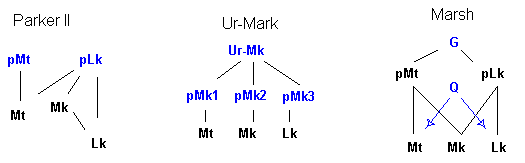
It would be distorting the matter, of course, to say that these proto versions are the newest (Parker II dates around 1980, but Streeter's version of the Four Source is 1924). But these hypothetical sources were invoked specifically to account for all the data - in this case, in the differences in the gospel accounts.
Not Settled
What are we to make of this? The point I want to make here is that this is not a slam dunk, despite appearances. Introductions to the New Testament in college and seminary tend to treat this as a solved problem, but it is decidedly not.
William Farmer, perhaps the foremost defender of the Griesbach model, discusses the contention between this and the Two Source model. However, his comments provide an insight into the general predicament.
"Unless defenders of the Two Source Theory can produce new arguments to defend that theory, and renew critical confidence in it, source criticism in Gospel studies appears destined to remain at an impasse. The only other way this impasse can be broken, it seems to me, is by some development in Gospel studies that will satisfy the critical need for a comprehensive solution to this problem." (The Present State of the Synoptic Problem)
Eta Linnemann, in her book Is There a Synoptic Problem?, does a modern statistical analysis of the actual wording of the three synoptic gospels, and discovers that in the material which all three share in common, only about 50% of the words are the same! In other words, the differences are so extensive in her view it's no wonder a satisfactory explanation has not been forthcoming.
E.P. Sanders, in The Tendencies of the Synoptic Tradition (1969):
"The evidence does not seem to warrant the degree of certainty with which many scholars hold the two-document hypothesis. It would also seem to forbid that a similar degree of certainty should be accorded to any other hypothesis. . . . I believe our entire study of the Synoptic Gospels would profit from a period of witholding judgments on the Synoptic problem while the evidence is resifted. . . I rather suspect that when and if a new view of the Synoptic problem becomes accepted, it will be more flexible and complicated than the tidy two-document hypothesis." (p 278 ff)
John A.T. Robinson, in Redating the New Testament (1976):
"The gospels as we have them are to be seen as parallel, though by no means isolated, developments of common material for different spheres of the Christian mission, rather than a series of documents standing in simple chronological sequence. This still allows the possibility that Matthew, say, may have been affected by Mark in the course of the redactional process, or indeed Luke by Matthew, without requiring us to believe that one is simply to be dated after the other.
We have been accustomed for so long to what might be called linear solutions to the synoptic problem, where one gospel simply 'used' another and must therefore be set later, that it is difficult to urge a more fluid and complex interrelation between them and their traditions without being accused of introducing unnecessary hypotheses and modifications." (p 94)
And so, even though the Traditional Solution seems to be set in stone, it is not. We will examine the foundations of the theory and see if they hold up.
Significance
What Does it Matter?
I will have to admit that for me this used to be absolutely one of the most boring topics imaginable in New Testament studies. When we went through this in college, I managed to ignore all the detail and accepted the prevailing Four Source theory. I blissfully accepted this as fact for 25 years before examining the issue for myself, quite by accident.
What does it matter?
(1) Contradictions. If two of the Synoptic authors intentionally deviated significantly from their sources, it's easy to say that they were correcting their sources, or they were inventing their own stories. If every departure is intentional, then each omission may be considered a statement of contradiction.
(2) Apostolic authorship. If Matthew copied from Mark, it is less likely that he was one of the original disciples. Why wouldn't a disciple tell his own version of the story? Why would he defer to a document that was at best written by a second-generation follower of Jesus?
(3) Late dating. Literary dependence is used as an argument for late dating of the gospels. If Mark, for instance, is considered the earliest gospel, and dated around 70, and if Matthew copied from Mark and Luke from Matthew, and John from all of them - and if we assume that a gospel needed to be in circulation for ten years before it was widespread, plausible dates for the other three gospels are 80, 90, and 100.
(4) Metaphorical Gospel. The "invention" concept gives rise to the idea of redaction criticism. In a euphemistic way, we are told the authors were "creative" authors, not just scissors-and-paste editors, creating their own faith stories. This gives rise to the Metaphorical Gospel Theory, which calls into question the very nature and meaning of the text.
Crossan
John Dominic Crossan has expressed this well (italics mine):
“Over the last two hundred years, however, comparative work on the Gospels has slowly but surely established certain results and conclusions. … Fourth, differences and discrepancies between accounts and versions are not due primarily to vagaries of memory or divergences in emphasis but to quite deliberate theological interpretations of Jesus. Finally, and in summary, the continuing presence of the risen Jesus and the abiding experience of the Spirit gave the transmitters of the Jesus tradition a creative freedom we would never have dared postulate were it not forced upon us by the evidence. Even, for example, when Matthew or Luke are using Mark as a source for what Jesus said or did or what others said or did to Jesus, they are unnervingly free about omission and addition, about change, correction, or creation in their own individual accounts—but always, of course, subject to their own particular interpretation of Jesus.” (Crossan, The Historical Jesus – the Life of a Mediterranean Jewish Peasant, HarperSanFrancisco 1991, Prologue, p xxx)
Let's break apart his points.
1. I have heard it said that there are only two things in New Testament studies that are considered fixed - certain conclusions: textual criticism, and the literary dependence of the synoptic gospels. Crossan, along with other scholars, feels no need to dig this up by the roots - but simply builds upon this firm foundation.
2. The differences between the synoptics were conscious, deliberate changes, corrections, or complete creations.
3. These variations were primarily due directly to theological motive.
4. The writers are "unnervingly free" in their creativity - so much so that it is startling, surprising.
5. And, finally - the clincher - scholars only hold this view about gospel composition because the evidence forces this conclusion!
The point of this article is to question the foundation of this whole structure. If the foundation is false, the conclusion is no longer "forced" by the evidence. We are free to reject the otherwise startling conclusion, and perhaps frame something more in accord with the truth.
An Argument Against Literary Dependence
The Challenge
How did I become interested in this issue? I ran across a book by John Dominic Crossan at the bookstore. He claimed in this book that if you just looked at the gospels side-by-side you would see that they flatly contradicted each other in so many places you'd be amazed. I bought a "harmony of the gospels" (Gospel Parallels) and started to look at how they differed from each other. I was looking for two things, actually: (1) I wanted to see how Matthew Hebrew-ized Mark's gospel, and how Luke Roman-ized it, and (2) I wanted to see what outright contradictions might exist.
The only contradiction I found was the "Bob Bennett contradiction" ("staff or not a staff"), which I already knew about and have discussed elsewhere (I chalk it up to a scribal error which was meticulously preserved - in the face of what must have been great psychological pressure to correct - ever since).
(1) My first impression was, as I looked closely at the differences, time after time I couldn't figure out why Matthew or Luke would want to change this to that. I could not, especially, discern any theological or communicative reason for changing the wording of similar accounts. I was reading the English (NAS) version, so I didn't have a look at the Greek itself. But the wording was so different that I thought this would probably not matter.
(2) My second impression was that there was a lot more verbatim agreement in the passages where Jesus is quoted than in the narrative passages. It seemed as if the "setup" narrative was pretty free-form, but the sayings showed more verbal agreement.
Example - Feeding of the Five Thousand
Scholars who have examined this issue have typically looked at the content of whole passages, noting the number of passages found/not found in the three gospels. Their debate has largely focused on explaining why two authors should include a passage not found in the other. However, let us not use the story or saying as our unit of investigation, but rather the words in the stories. As Eta Linnemann says (Is There a Synoptic Problem?), this is the atomic level of meaning for the text. Let us look at passages that Matthew, Mark, and Luke have in common and try to discern, where they differ, why they differ.
I
will choose one example, almost at random. Nearly any comparison of this
kind of common material
would do just as well. I chose this because it was primarily narrative;
all three authors cover the same content; and there is substantial verbal
agreement.
This is the story of the feeding of the five thousand. I just lay out
the phrases side-by-side and don't color them for you or try to influence your
impression in any way. But YOU need to read these carefully, and even
mull over them, as I did.
| Mark
6.35-44 And when it was already quite late, His
disciples came up to Him and began saying, “The place is desolate
and it is already quite late; send them away so that they may go into
the surrounding countryside and villages and buy themselves something
to eat.” And
they said to Him, “Shall we go and spend two hundred denarii on
bread and give them something to eat?” |
Matt
14.15-21 And when it was evening, the disciples came to Him, saying, “The place is desolate, and the time is already past; so send the multitudes away, that they may go into the villages and buy food for themselves.”
|
Luke
9.12-17 And the day began to decline, and
the twelve came and said to Him, “Send the multitude away, that they
may go into the surrounding villages and countryside and find lodging
and get something to eat; for here we are in a desolate place.” |
|
|
|
|||
| And
He said to them, “How many loaves do you have? Go look?!”
And when they found out, they said, “Five and two fish.” And He commanded them all to recline by groups on the green grass. And they reclined in companies of hundreds and of fifties. |
And
they said to Him, “We have here only five loaves and two fish.”
And
He said “Bring them here to Me.” |
And
they said, “We have no more than five loaves and two fish, unless
perhaps we go and buy food for all these people.” (For there were about five thousand men.) And He said to His disciples, “Have them recline to eat in groups of about fifty each.” And they did so, and had them all recline. |
|
|
|
|||
| And
He took the five loaves and the two fish, and looking up toward
heaven, He blessed the food and broke the loaves and He kept giving
them to the disciples to set before them; and He divided up the two
fish amount them all.
|
He
took the five loves and the two fish, and looking up toward heaven, He
blessed the food, and breaking the loaves He gave them to the
disciples, and the disciples gave to the multitudes. |
And He took the five loaves and the two fish, and looking up to heaven, He blessed them, and broke them, and kept giving them to the disciples to set before the multitude. | |
Notice that the content is the same, the order is the same, and some of the key phrases are the same ("You give them something to eat." - and "And He took the five loaves and the two fish, and looking up toward heaven, He blessed the food and broke ...") But the wording of the rest differs in trivial ways.
We must ask ourselves, "Why would any of the authors deviate from the others, in these specific ways?" This is the situation that I, at any rate, find when I look at the parallel accounts given by the synoptics. I won't comment on each issue (although later I will consider other examples and go through them); you must look at them for yourself.
Here's my impression: If you asked three people to write independent accounts, you wouldn't get anything much different from the above (except perhaps for the phrasing of the blessing of the fish and loaves). From strictly a standpoint of literary textual analysis, these three versions are relatively independent accounts of the same event, and I can't see how someone would conclude - purely from the words used - that any account directly copied any other.
And this went on. I took the time to go through many, many of the parallel accounts in just this way, puzzling over the differences, and it was astonishing how many and varied they were. Be clear that I assumed that Marcan Priority was true, and had no problem with it. But I remember a definite time when I put the Gospel Parallels down in disgust and said to myself, "There's just no way these guys copied from each other."
The Encyclopedia Homework Theory
This
brings me to the “Encyclopedia Homework” theory. I remember doing
little reports in junior high school. I would look up the topic in the
encyclopedia, and then try to re-phrase what it said for my paper. If I
happened to be hurried or tired or lazy at the time, I just copied blocks of
text, hoping that no one would notice. In fact, sometimes it was so hard
to re-phrase what was already there that I just copied it down verbatim.
Wouldn't it have been much easier, if Matthew were copying from Mark (for instance), for him to just copy the narrative verbiage down as is, rather than try to paraphrase it, especially when the paraphrase is for no discernable reason?
Theological Differences
According to the current thinking, the gospel writers are often motivated by theological reasons for "shaping" the material they have in front of them into a new gospel. Statistically, however, there is much more "shaping" of the wording in the narrative material than there is for Jesus' sayings.
If theology were a prime motivation, you would expect the situation to be exactly the reverse. You would expect the wording of the sayings (extremely theological) to vary dramatically, and the wording of the "setup", the narrative material, to largely agree. But they don't.
Grammatical Differences
It has been claimed that the apparently trivial differences in wording are due to Matthew's and Luke's attempts to clean up Mark's poor grammar and style. First, it would not logically follow, from the mere fact in itself that Matthew and Luke express themselves more elegantly or correctly, that they are intentionally improving Mark's account. Their better grammar might equally be as noticeably present if they simply happened to be better writers.
But beyond this, if we want to judge whether the differences we see are always (or even typically) due to stylistic considerations, we must go into the details of Greek style. Even for those who have studied New Testament Greek, this goes beyond what can be expected. We will have to defer to experts in these matters.
However, if you look at the English translation, you can see for yourself many variations that couldn't possibly be due to stylistic improvements. Sometimes one author will substitute a pronoun for a proper name, and vice versa. Sometimes one author will include a small phrase that the others don't. Go back up to the Feeding the Five Thousand example above, and see how this is true.
Literary Dependence
Let's say you and I are in school and have a homework essay assignment. We turn in absolutely identical essays. The teacher would probably conclude that one of us had copied from the other. But even where there is a high degree of similarity, direct dependence is not the only possibility. It's possible that we each bought our essays from Sam, the essay peddler. Our essays are not dependent upon each other, but upon a common source.
In fact, this assumption has been called the Clock Maker's Fallacy. In a clock shop, all the clocks chime together at exactly 12:00. This doesn't mean that they are all dependent upon each other - they are, in fact, very independent of each other, but are made to run the same way, at the same speed, and so on.
A further example: Picture a rapid-fire automatic weapon, with bullets following each other in a flat arc. If all you saw were the bullets, you might be tempted to think that they are following each other and thus each bullet is dependent upon the preceding one. But that's not the case. As in the essay example, they are all dependent upon a common source, the firing of the gun.
So, it would be possible, even if the three synoptics demonstrated a high degree of similarity, that they are all dependent upon a common source.
Conclusion
Let's sum up what we've found so far. We see that the Matthew, and Luke, while presenting their own material, present material found in Mark, typically follow Mark's generally content and order. And we can see, from many, many examples such as the one offered above, that the specific wording differs in these accounts, often in trivial ways.
And we have seen that the verbal identity of all three synoptics is at most 50%. Simply based on this, which is more plausible, that they copied each other half the time and revised the other half (often in trivial ways), or that they are ultimately dependent in some way upon a common source?
How do we explain the differences we see? The scenario above suffers from these fairly significant problems:
- The authors deviate from each other, when it would have easier to simply copy the text in front of them than to re-phrase.
- The re-phrasing can't be explained only by improvements in grammar.
- These are often trivial changes - they aren't influenced by theology at all.
Bottom line: The Direct Literary Dependence hypothesis explains, by definition, the similarities between the synoptics, but does not explain the differences.
But there must be more to this. Such a venerable theory cannot be so easily dismissed on the basis of my amateur impressions! In the next chapter, we will look at the main arguments in favor of the Traditional Solution, and consider this more closely.
References
Web Resources
The Synoptic Problem Home Page. Excellent overview of the varying theories, with lists of further resources and discussion lists.
NT Gateway - Online Synoptic Articles. Especiall Austin Farrer's and Farmer's.
The Present State of the Synoptic Problem, Farmer
On Dispensing with Q, Farrer.
Books
Stoldt, Hans-Herbert. History and Criticism of the Marcan Hypothesis
Wenham, John. Redating Matthew, Mark, and Luke - a Fresh Assault on the Synoptic Problem
Farmer, William R. The Synoptic Problem - a Critical Analysis (1976)
Linnemann, Eta. Is There a Synoptic Problem?
Notes
[1] Farmer emphasizes that the Synoptic Problem has not been solved, even describing the situation as an "impasse": ("The Present State of the Synoptic Problem")
"Unless defenders of the Two Source Theory can produce new arguments to defend that theory, and renew critical confidence in it, source criticism in Gospel studies appears destined to remain at an impasse. The only other way this impasse can be broken, it seems to me, is by some development in Gospel studies that will satisfy the critical need for a comprehensive solution to this problem."
"They [Sanders-Davies] have suceeded in clarifying in an original way why the Two-Source theory is critically 'unsatisfactory' and in pointing out the remaining difficulties (no mean achievement) standing in the way of fully accepting any one of the major alternative theories now under consideration.
[5] Challenging Assumptions. Austin Farrer explains (On Dispensing with Q):
"It would certainly be impertinence to suggest that the scholars who established the Q hypothesis reasoned falsely or misunderstood their own business; no less an impertinence than to talk of the great "Scholastics so. St. Thomas understood the business of being an Aristotelizing "Augustinian, and if I am not his disciple, it is not because I find him to have reasoned falsely. It is because I do not concede the premisses from which he reasoned. And if we are not to be Streeterians, it will not be because Dr. Street reasoned falsely, but because the premisses from which he reasoned are no longer ours." (i)